
.png)
.png)
Title:
Should I consider a vertical solar wall?
Writer:
Natassja Lindrea
Category:
Date
December 16, 2025

December 16, 2025
ARTICLE
Should I consider a vertical solar wall?
While a north-facing roof remains the most effective location for solar overall, not every home has suitable roof space or energy needs that align with maximising annual output. Modelling shows that although a vertical north-facing solar wall produces less energy annually, it can outperform a roof during winter months when energy demand is highest—particularly in all-electric homes. A vertical solar wall isn’t a replacement for rooftop solar, but in the right conditions, it can be a practical way to supplement generation when roof space is limited or compromised.
A question inspired by our Volt exhibition stand at ArchiBuild
Should I consider a vertical solar wall?
For most people, the starting assumption is that solar belongs on the roof, and ideally on a north-facing roof. That assumption is generally correct from a total annual generation perspective. But in practice, not every home has usable north-facing roof space, and not every energy profile benefits from maximising annual output alone.
So the real answer is: it depends, and it’s worth understanding when a vertical solar wall might make sense.
Why the question comes up in the first place
Many homes have limited or compromised roof space. North-facing roof planes may be shaded by trees, chimneys, or neighbouring buildings, or they may be heavily interrupted by skylights and architectural elements. In other cases, the available roof area is simply too small to accommodate the system size required.
In these situations, east and west-facing roofs are often used instead. While they generate less total energy than north-facing systems, they can align better with real-world usage, particularly for households that aren’t home during the middle of the day. East/west systems can also reduce battery cycling, helping extend battery life.
Location also plays a role. As you move further north in Australia, the sun sits higher in the sky, improving the performance of south-facing roofs compared to what we see in southern states like Victoria.
All of this raises a reasonable follow-up question: if we’re already thinking beyond the “perfect” north-facing roof, should walls also be considered?
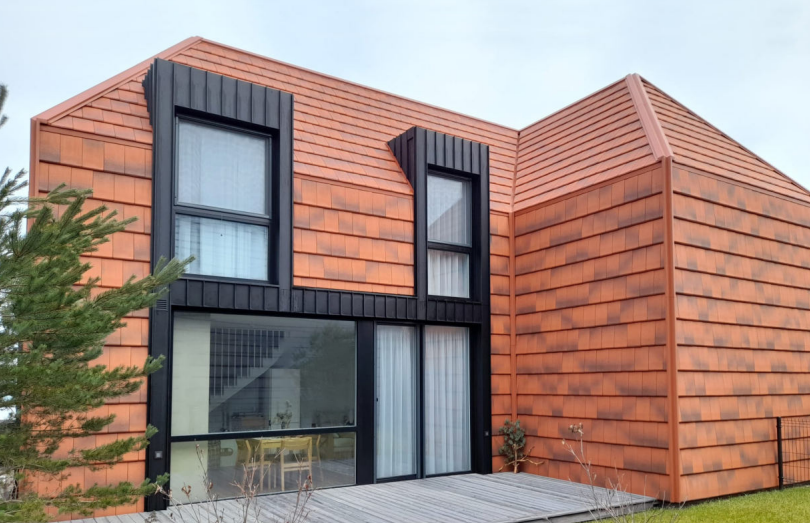
Comparing orientations using real data
To explore this, we modelled a 6.4kW Volt solar tile system at our office location in Eltham, Victoria. All roof planes were set at a 20-degree pitch with no shading to keep the comparison consistent.
The simulated annual generation was:
- North-facing roof: 8,343 kWh per annum
- West-facing roof: 7,423 kWh (89% of north)
- East-facing roof: 7,191 kWh (86% of north)
- East/West split: 7,351 kWh (88% of north)
- South-facing roof: 6,151 kWh (73% of north)
These figures confirm that while north-facing roofs perform best overall, other orientations can still deliver a high percentage of the output, particularly when matched to household energy use.
So how does a vertical wall perform?
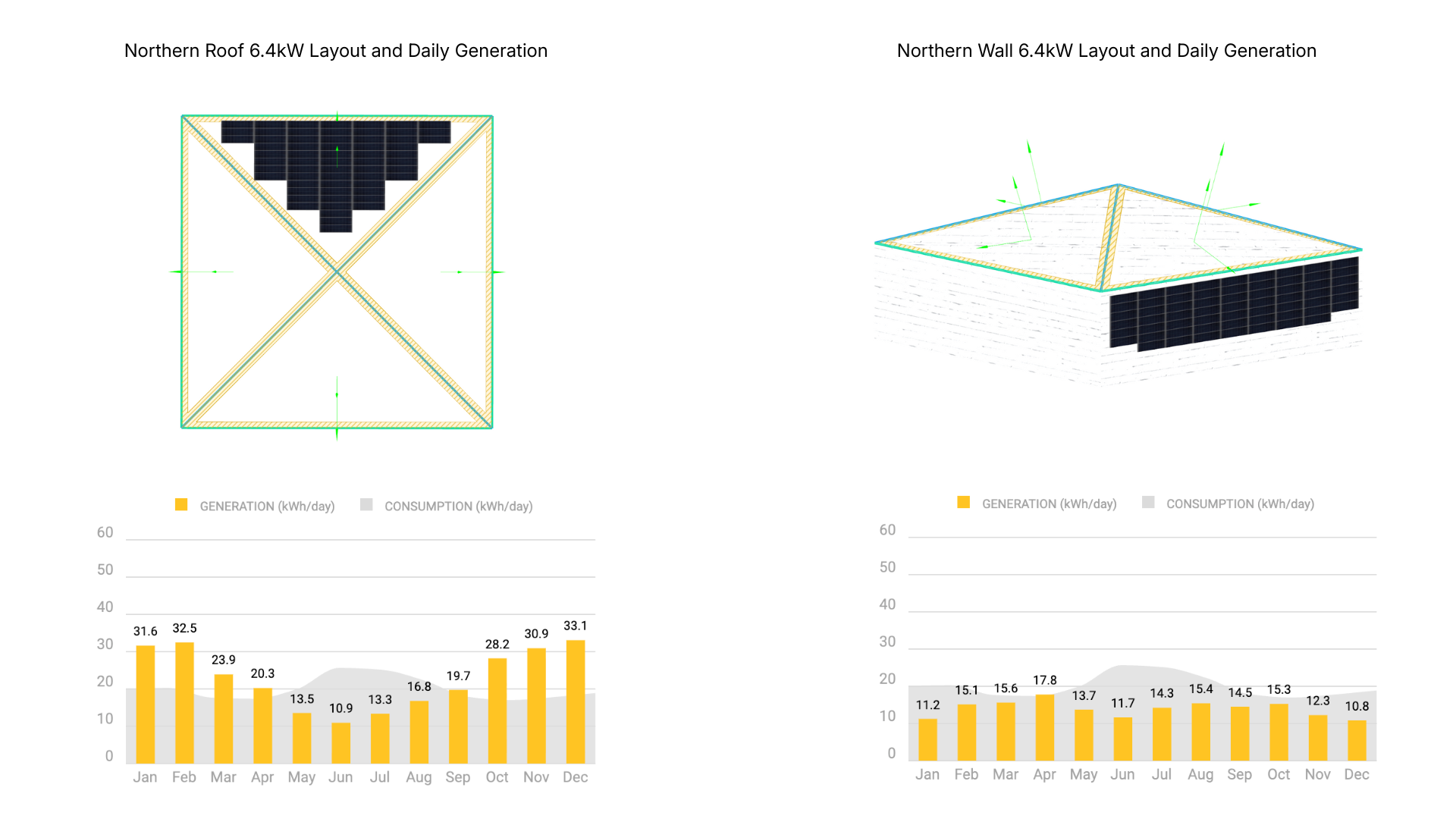
We then modelled the same 6.4kW system installed on an unobstructed, north-facing wall.
On an annual basis, the wall generated 5,101 kWh, only 61% of the north-facing roof. From a purely annual yield perspective, a wall is clearly less productive than a well-positioned roof.
However, annual totals don’t reflect when that energy is produced.
When we looked at daily generation across the year, a different pattern emerged. From May through July, when the sun is lower in the sky, the north-facing wall outperformed the roof on a daily basis.
This is also the period when homes in Melbourne require more energy, particularly for heating in all-electric homes.
The practical answer
So, should you consider a vertical solar wall?
If you have good, unobstructed north-facing roof space, a wall is unlikely to be a better option. Roof-mounted solar remains the most effective way to maximise annual generation.
But a vertical solar wall is worth considering when:
- Roof space is limited or heavily shaded
- Winter energy performance is a priority
- The home is all-electric, and heating demand is high
- You’re looking to supplement rooftop solar rather than replace it
In these scenarios, a north-facing wall can add meaningful winter generation without competing for valuable roof space.
In short, a vertical solar wall isn’t a default solution—but in the right conditions, it can be a smart, complementary one.
Written by Peter Noye
Business Development Manager, Volt
Natassja Lindrea is the marketing and brand lead at Volt Solar Tiles, working at the intersection of design, construction, and energy. With a background spanning marketing, storytelling, and the built environment, her work focuses on translating complex technical ideas into clear, grounded insights for Australian homes. She writes about building-integrated solar, architectural decision-making, and why context matters when designing for local conditions.
.png)
Written By
